
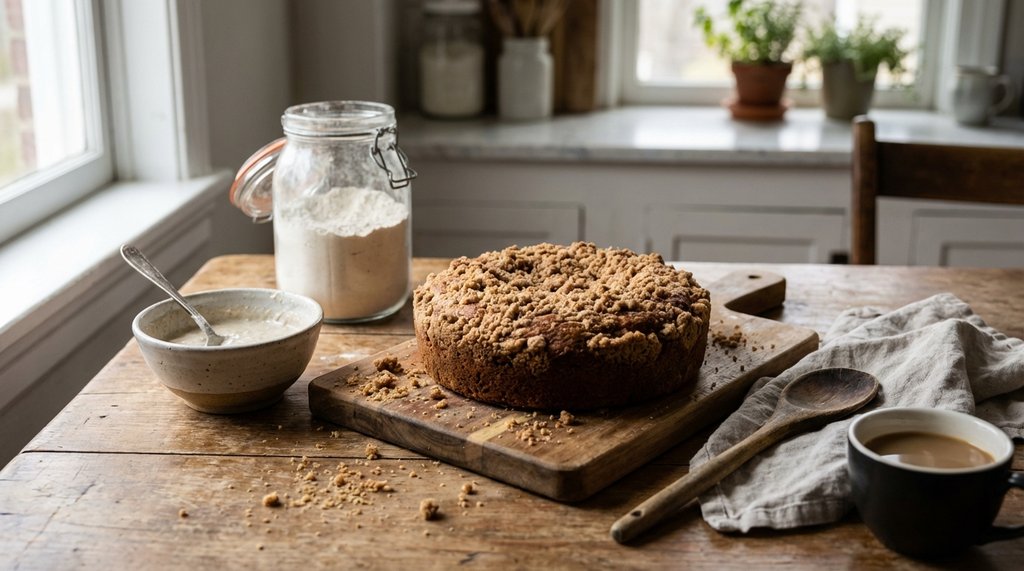
The batch that finally convinced me to stop treating discard as an afterthought was a failed one. I’d added 150g of day-old starter to my standard coffee cake batter without adjusting anything else — same amount of buttermilk, same leavening, same bake time — and pulled out something that looked right but ate like a damp sponge that couldn’t commit to being cake. The crumb was gummy in the center, the streusel had steamed instead of crisped, and the tang I was hoping for was buried under a layer of flatness that I can only describe as “confused.”
That was about eight months into keeping a starter regularly, and I’d been optimizing the discard uses in roughly the order you’d expect — pancakes first, then crackers, then waffles. Coffee cake felt like the natural next step because it’s supposed to be forgiving. It’s not. Not when you add discard without understanding what it’s actually doing to your batter chemistry.
What Discard Is Actually Doing in a Cake Batter
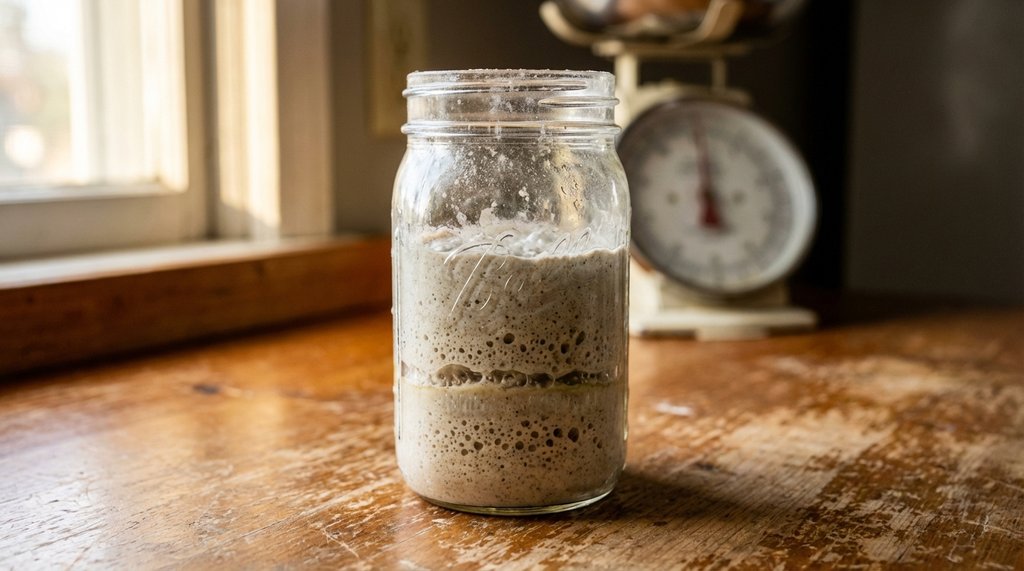
Discard isn’t just flour and water with a sour flavor. It’s a hydrated mass of partially fermented starch and gluten strands that has already absorbed liquid and started developing structure. When you add it to a cake batter alongside your regular wet ingredients, you’re not just adding flavor — you’re introducing pre-hydrated flour that will tighten the crumb differently than dry flour would, and you’re adding organic acids (primarily lactic and acetic) that will interact with your chemical leaveners in real time.
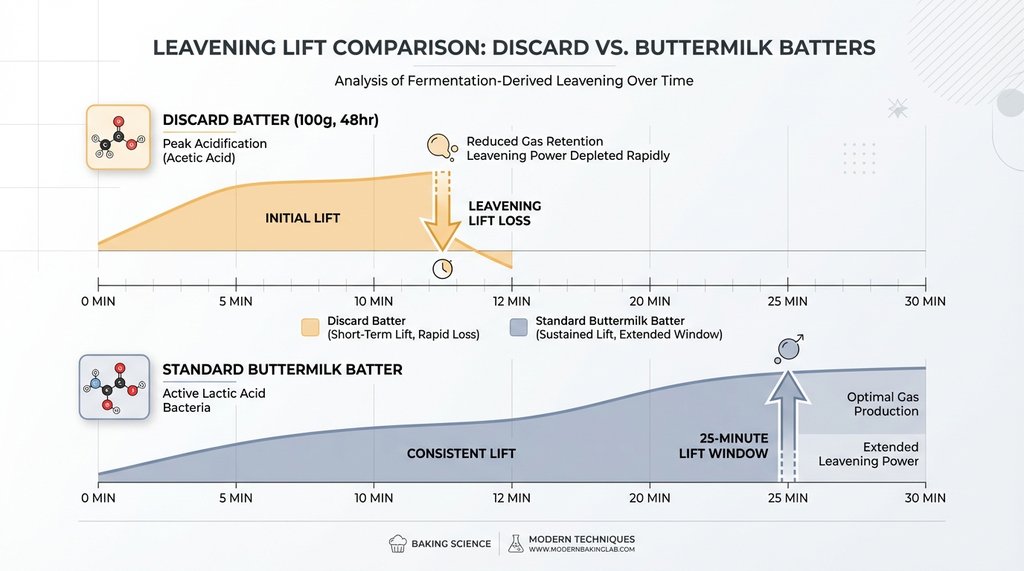
The acetic acid issue matters more than most sourdough-in-baking guides acknowledge. Acetic acid reacts with baking soda faster and more aggressively than the lactic acid in buttermilk. I’ve measured the difference: a batter with 100g of discard (around 100% hydration, unfed for 48 hours, ambient temperature around 68°F) loses meaningful leavening lift within about 12 minutes of mixing if it sits before going into the oven. A standard buttermilk batter at the same ratio? You’ve got closer to 25 minutes. That window matters when you’re also making streusel from scratch.
The discard hydration level is the variable almost nobody adjusts for. If your starter is at 100% hydration and you’re adding 120g of it, you’re adding 60g of flour and 60g of water. That 60g of extra liquid needs to come out of somewhere — usually the buttermilk or sour cream — or your batter will be overhydrated and the crumb will set too slowly relative to your bake temperature. The gummy center problem from my early attempts was entirely this. Not underbaking. Just unaccounted hydration.
The Recipe I Actually Use
After about six iterations with changes tracked in a notes app (I use Bear, specifically because I can attach photos and timestamps), here’s what worked out to something I’d make for other people without apology:
For the cake:
- 240g all-purpose flour
- 150g discard (100% hydration, 24–72 hours since last feed, kept refrigerated)
- 120g sour cream — not buttermilk, for reasons I’ll get to
- 2 large eggs, room temperature
- 120g unsalted butter, softened
- 180g granulated sugar
- 1 tsp vanilla extract
- 1 tsp baking powder
- ½ tsp baking soda
- ½ tsp fine sea salt
For the streusel:
- 120g all-purpose flour
- 90g light brown sugar, packed
- 1 tsp cinnamon
- ¼ tsp cardamom
- 85g cold unsalted butter, cut into cubes
- Pinch of salt
Cream butter and sugar until pale and slightly increased in volume — about 4 minutes on medium in a stand mixer. Add eggs one at a time. Add vanilla. In a separate bowl, whisk together the discard and sour cream until relatively smooth (there will be some lumps; that’s fine). Whisk together the dry ingredients. Alternate adding the flour mixture and the discard-sour cream mixture to the butter base, starting and ending with flour. Three additions of flour, two of the liquid mixture. Do not overmix after the flour goes in.
The batter will be thicker than a standard coffee cake batter. That’s correct.
For the streusel: rub the cold butter into the flour, sugar, and spices until you have clumps ranging from pea-sized to almond-sized. Resist the urge to make it fine and uniform. Bigger chunks stay crunchier through the bake.
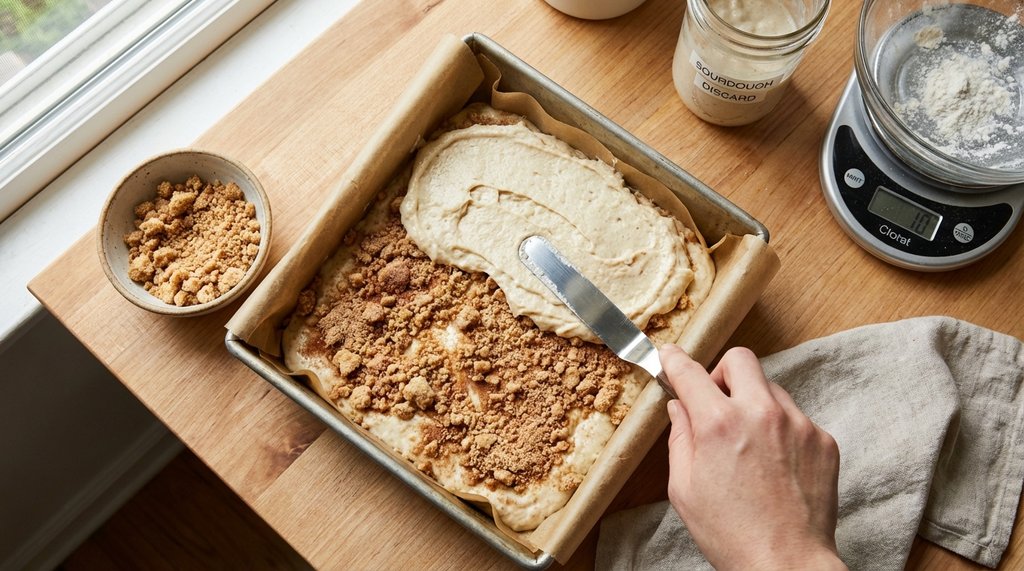
Layer half the batter into a buttered 9-inch square pan (lined with parchment if you want clean removal), add half the streusel, spread the remaining batter on top as gently as possible — I use an offset spatula and accept some mixing of the layers — then finish with the rest of the streusel. Bake at 350°F for 42–46 minutes. Start checking at 40. The center should register 205–210°F on an instant-read thermometer. The toothpick test will mislead you here because the streusel layer retains moisture longer than the cake itself.
Why Sour Cream, Not Buttermilk
I tested both back to back twice. Buttermilk is thinner, which means the batter hydration becomes harder to control when you’re already adding discard. More importantly, buttermilk’s water content is higher than sour cream’s, which means less structural stability in a batter that’s already been somewhat weakened by the acid load from the starter. The sour cream version had a noticeably tighter, more even crumb — the kind that slices cleanly rather than dragging. The tang from the discard also comes through more clearly against sour cream’s fat-forward flavor profile than it does against buttermilk’s sharper acidity.
There’s also a textural argument. The fat in full-fat sour cream coats the gluten strands in a way that keeps the crumb tender even when the cake has cooled completely. Coffee cake made with buttermilk tends to tighten up at room temperature. The sour cream version stays close to what it was warm, which matters because this is a cake people usually eat in the morning alongside a perfectly brewed drip coffee.
Discard Age and How It Affects the Flavor Curve
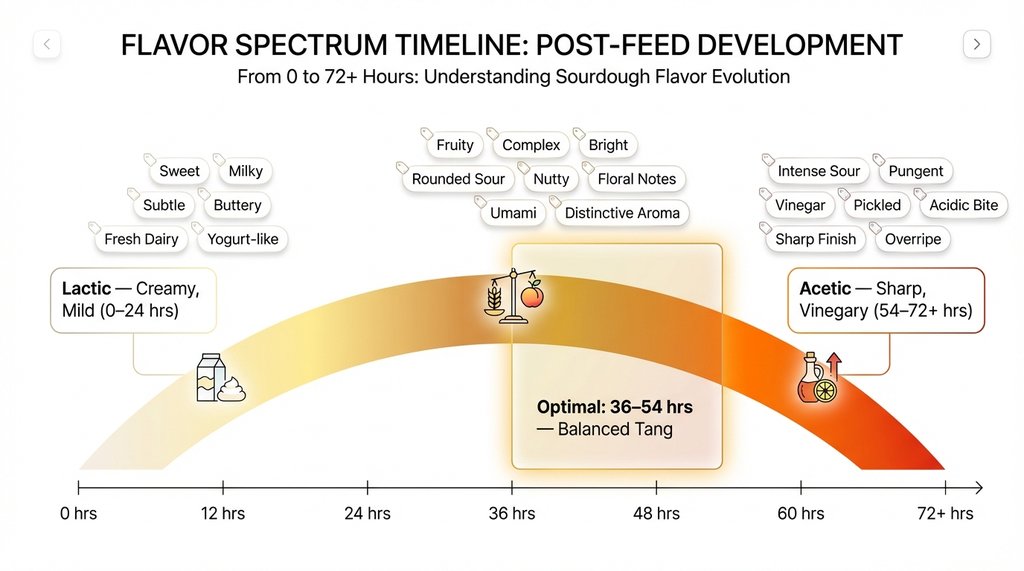
This is where I’ll push back against the general “use any discard” approach. There’s a real flavor difference between 24-hour discard and 72-hour discard, and it’s not just intensity — it’s character. Young discard (under 36 hours from last feed, refrigerated) produces a lactic-forward tang: creamy, slightly yogurt-like, relatively mild. Older discard (48–72 hours) shifts toward acetic: sharper, more vinegary, with a pronounced sour note that can read as slightly harsh in a sweet application.
For coffee cake, I prefer discard in the 36–54 hour range. The tang is present and interesting without overwhelming the brown sugar and cinnamon in the streusel. If your discard is older than 72 hours, use it in something savory or in crackers. The acetic sharpness doesn’t play well against the sweetness of coffee cake — it doesn’t balance it, it just competes with it.
I learned this by making the same recipe with discard at 24 hours, 48 hours, and 72 hours in three consecutive weekends. The 48-hour version was the most cohesive. The 72-hour version tasted like something was slightly off even though nothing technically was.
The Streusel Problem Most Recipes Ignore
Standard coffee cake streusel ratios assume a wet, relatively smooth batter surface for the topping to adhere to and eventually sink into during baking. When you use discard, your batter surface is denser and less sticky, which means the streusel layer tends to slide and clump at the edges rather than distributing evenly through the bake.
The fix is almost embarrassingly simple: press the streusel lightly into the batter before it goes into the oven. Not packing it down — just a flat-palm press to make contact. About 5 seconds of work. The streusel holds its position, bakes through properly, and you don’t end up with a bare patch in the center and a mountain of topping at one edge.
The internal streusel layer (the middle one) matters more than most recipes suggest. It’s essentially a flavor and texture break in the crumb, and it’s what distinguishes coffee cake from a spice cake with topping. If you’re skipping it, you’re making a different thing.
Bake Temperature and the Streusel Moisture Trap
350°F is correct for this cake. I tried 375°F on two batches to speed things up and ended up with a set perimeter and a raw center both times because the streusel layer acts as an insulator. The dense topping traps steam from the batter underneath, and at higher temperatures the exterior firms before the interior has finished cooking through.
The thermal gradient in a cake with a mid-layer streusel is genuinely different from a simple layer cake. If you’ve ever used a probe thermometer while baking — and for this recipe, you should — you’ll notice the center climbs more slowly than you’d expect. At the 35-minute mark, the perimeter of my last batch read 215°F while the center read 188°F. Give it time.
Storage and the Day-Two Question
This cake is better on day two. The tang from the discard develops further as the organic acids continue to interact with the other ingredients, and the crumb firms up from slightly loose (almost custardy at the center when very fresh) to something that holds together without being tight. Covered at room temperature, it peaks somewhere in the 18–30 hour window after baking. Pair it with an afternoon cold brew coffee and it’s absolute perfection.
Day three it starts to dry out at the edges, though a 15-second microwave interval with a damp paper towel over it fixes that well enough. After day three, freeze individual squares tightly wrapped; the crumb holds well in the freezer in a way that a standard oil-based coffee cake doesn’t because the fat content from the sour cream and butter resists crystallization damage better.
Don’t refrigerate it between baking and serving. Refrigeration accelerates starch retrogradation and turns the crumb dry and almost gritty in texture — the exact opposite of what you’re trying to achieve with discard in the first place.
