
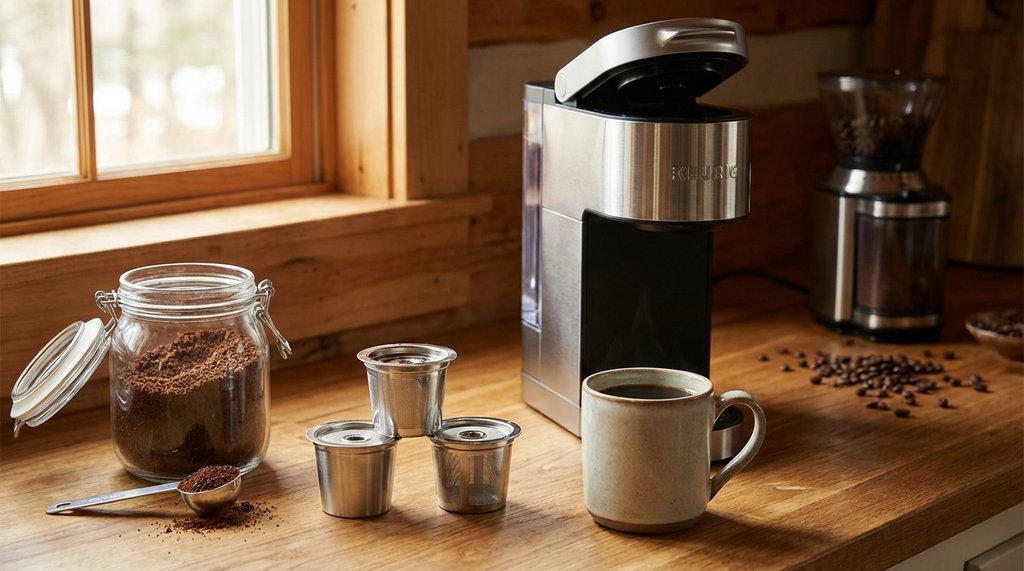
The first reusable pod I tried in the K-Supreme Plus nearly convinced me the whole category was a scam. I’d packed a medium grind — same brand I’d been using in my old K-Elite for two years without a single complaint — and what came out was a thin, sour 6-ounce cup that tasted like it had been filtered through a paper towel someone already used. I ran it three more times thinking the issue was me. It wasn’t me.
The problem is that almost no reusable pod review online accounts for what the K-Supreme Plus actually does differently. The MultiStream Technology — five needles punching through the lid instead of the traditional single needle — changes the entire extraction dynamic in ways that make most generic “just fill it up and brew” advice actively counterproductive on this machine.
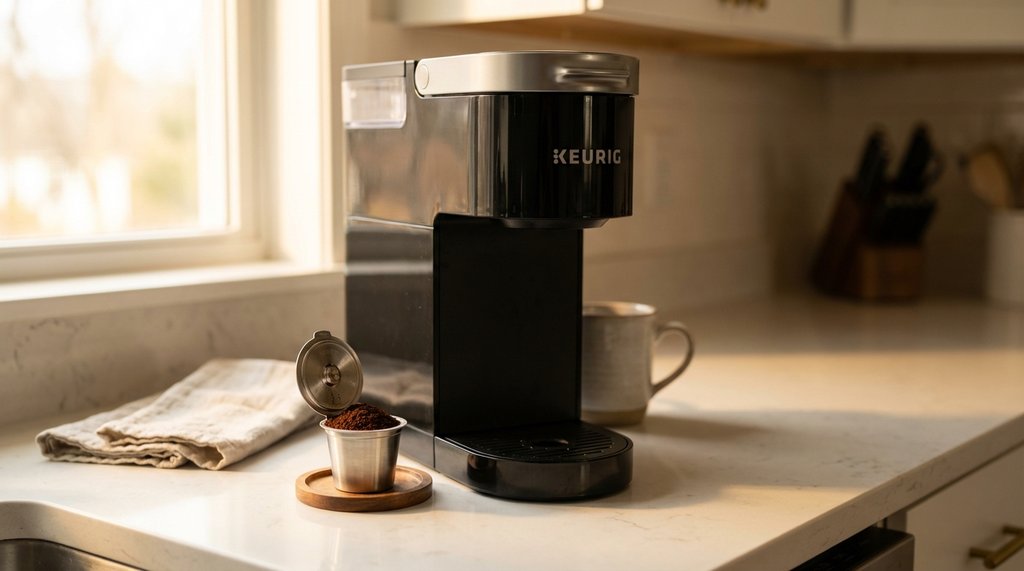
Why the K-Supreme Plus Breaks the Standard Reusable Pod Playbook
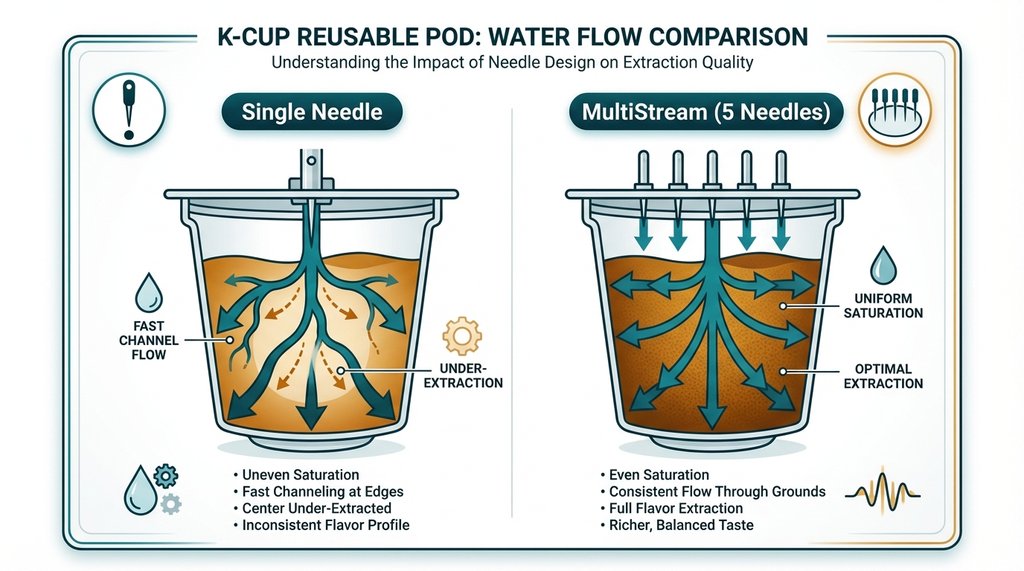
The five-needle array distributes water across the full bed of grounds rather than funneling it through a single entry point. In a well-designed disposable pod, this is excellent — uniform saturation, better bloom, fuller extraction. In most reusable pods, this becomes a channeling nightmare.
Here’s what actually happens: water from the outer needles hits the rim area of most reusable basket designs where grounds are thinner or compacted differently from the center. You get fast-channel paths at the edges, under-extraction in the middle, and a cup that tastes simultaneously weak and acidic — which is a particular kind of bad because it doesn’t even read cleanly as “just weak.”
I spent about three weeks in late 2023 running controlled comparisons — same beans (a Colombian medium-dark from a roaster I’ve used for years, roasted within the past 10 days for all tests), same water (filtered, ~150 ppm TDS), same machine, tracking cup temperature at first sip with a Thermapen and doing basic TDS readings with a VST refractometer. The differences between pods were not subtle. The worst performer hit 0.8% extraction TDS on an 8-oz brew setting. The best hit 1.35%. That’s not a marginal improvement — that’s the difference between a cup I’d serve someone and a cup I’d quietly pour down the drain.
The Pods That Actually Work, and Why
Keurig’s Own My K-Cup Universal Reusable Filter
I know. I didn’t want to recommend the OEM option either because it feels like a cop-out. But the reality is Keurig redesigned the My K-Cup for the K-Supreme Plus specifically, and they knew what they were doing. The lid is designed with five specific holes to safely accommodate the five needles — a problem I documented on older third-party pods where forcing the machine closed risks damaging the needles or punching improperly into the basket.
The basket has a wider-diameter base than most third-party options, which matters because it means your grounds bed is shallower relative to the pod volume. Shallower bed + MultiStream = more uniform saturation.
Fill level: 2 tablespoons of a medium grind gets me to the “max” line, but I’ve found going about 15% below the max line and using a light tamp (not espresso-level, just enough to level the surface) consistently outperforms a full, loose fill. This contradicts the instructions printed on the pod itself.
Grind setting: I’m running this on a Baratza Encore, and the sweet spot for the K-Supreme Plus on this pod is settings 14-17. Anything coarser than 18 and you’re into genuinely weak territory. Anything finer than 12 and the filter starts to restrict flow noticeably — you’ll see the brew time extend past about 90 seconds on an 8-oz pour, and the cup starts reading over-extracted and bitter despite the machine’s relatively low brew temperature.
Delibru Reusable K-Cup Pod
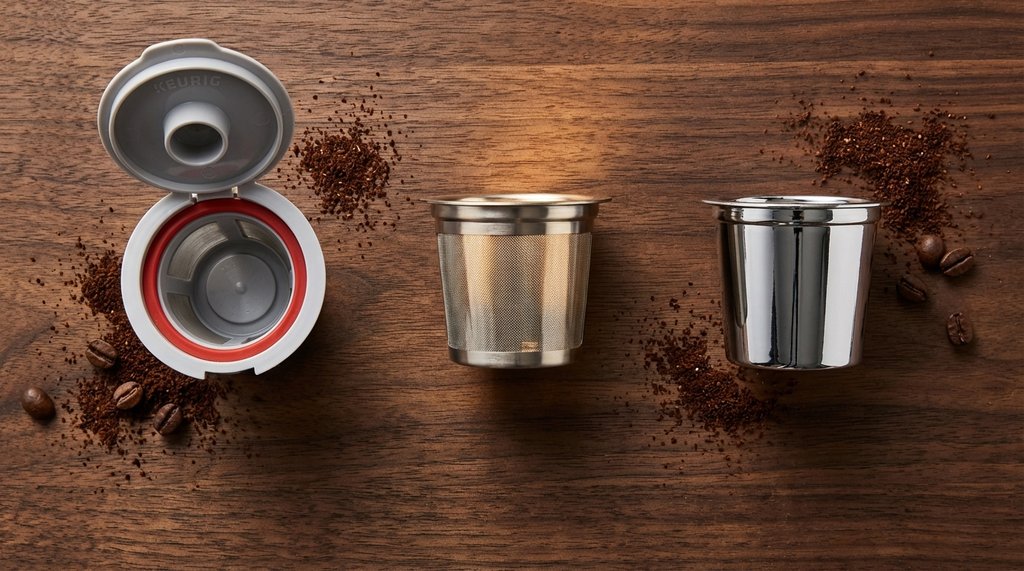
This is the one I actually use daily. The Delibru has a stainless mesh filter instead of plastic with perforations, and it handles the MultiStream needle pattern better than anything else I’ve tested because the mesh provides consistent resistance across the entire bed rather than relying on specific perforation placement.
What makes it work: the mesh tension is tight enough that medium-fine grinds don’t fall through, but the resistance is uniform, so you don’t get the channeling problem at the rim. I’ve run it probably 400 times at this point. The mesh has not deformed or loosened.
The one actual problem: the lid seal. After about 150 uses, I noticed occasional slow dripping from the needle entry points during brew — not enough to cause a mess, but enough that I was losing extraction pressure. Replaced the pod (Delibru sells them in inexpensive multi-packs) and it was fixed. The stainless mesh is highly durable, but treat the plastic hinges and seals as eventually consumable.
Grind setting for Delibru: I run a touch finer than I do with the My K-Cup — Encore setting 13-15. The mesh filtration handles finer particles without blinding the way a perforated plastic basket would.
Solofill Cup Chrome Reusable Filter
I’ll include this one because it’s been heavily recommended in the r/keurig community for a while and I want to address it directly: the Solofill Chrome performs well on older Keurig models and is essentially wrong for the K-Supreme Plus.
The issue is the hard plastic lid design, which is not designed for the five-needle array. Forcing the brewer closed on a non-compatible hard plastic lid can actually bend or break the machine’s needles. You won’t just notice a reduction in extraction—you risk permanently damaging your brewer. I pulled the pod after attempting to brew and could see the stress on the lid clearly. This is not a unit-tolerance issue — older Solofill cups simply do not have the required five-hole layout for the K-Supreme Plus.
If you already own older reusable cups and you’re migrating to the K-Supreme Plus, do not force the handle down if they lack the five-hole lid design.
Grind Size: The Part Most Guides Get Backwards
The persistent recommendation you’ll see is “use a coarser grind in reusable pods to prevent clogging.” This is correct advice for slow-drip systems and for Keurigs with single-needle entry points. On the K-Supreme Plus, it’s partially wrong, and getting it wrong costs you half your cup quality.
Because the MultiStream system distributes water more aggressively, it compensates for the slightly higher flow resistance of a medium-fine grind — resistance that would stall extraction in a single-needle machine. You can actually push finer and get better extraction, not worse flow, up to a point. The ceiling on the K-Supreme Plus is approximately a medium-fine (think drip machine spec, not espresso), not the medium-coarse that most guides recommend.
What I’ve found through actual refractometer measurements:
- Coarse grind (Encore 20+): TDS averaging 0.75-0.9% on 8 oz, regardless of pod type. Sour, thin, under-extracted.
- Medium grind (Encore 17-19): TDS averaging 1.0-1.15%. Better, drinkable, but still leaving extraction on the table.
- Medium-fine (Encore 13-16): TDS averaging 1.2-1.4%. This is where the machine actually performs. Flavor complexity comes through.
- Fine (Encore 10-12): TDS gets high (1.5%+), brew times extend noticeably, and flavor turns bitter. Not worth chasing.
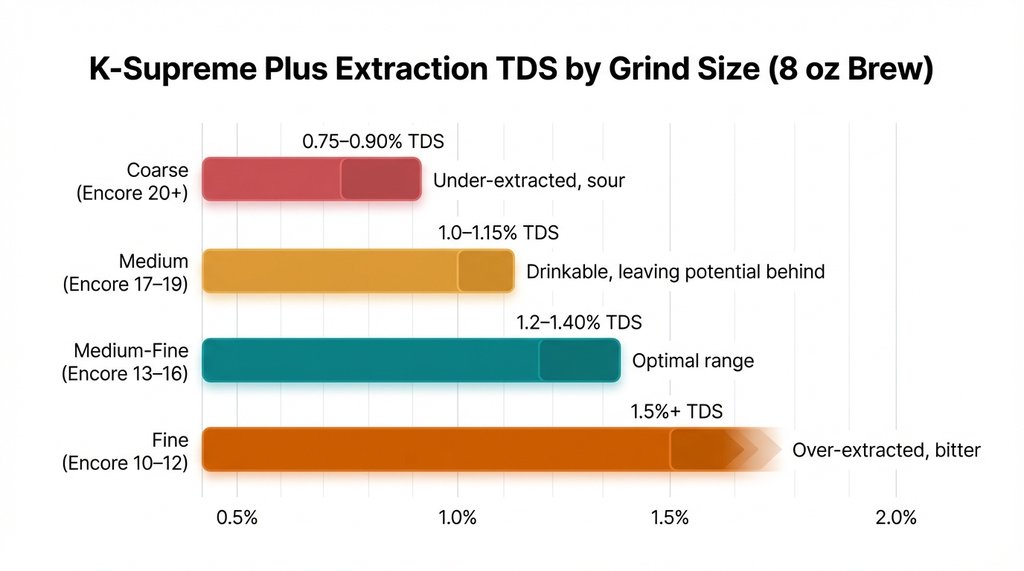
These numbers are from my specific setup — your beans, water, and machine calibration will shift the exact dial positions, but the directional finding holds: the K-Supreme Plus rewards going finer than you’d expect.
Fill Level Is a Bigger Variable Than Anyone Talks About
I wasted probably two months thinking my grind was the problem when fill level was the actual issue. Here’s the non-obvious relationship:
Overfilling a reusable pod on the K-Supreme Plus doesn’t just risk grounds escaping — it actually changes the extraction pressure profile. When the grounds bed is too high relative to the pod cavity, the entry needles are closer to the grounds surface. The water doesn’t have room to distribute laterally before entering the bed, so you’re back to single-needle-like channeling behavior even with a five-needle array.
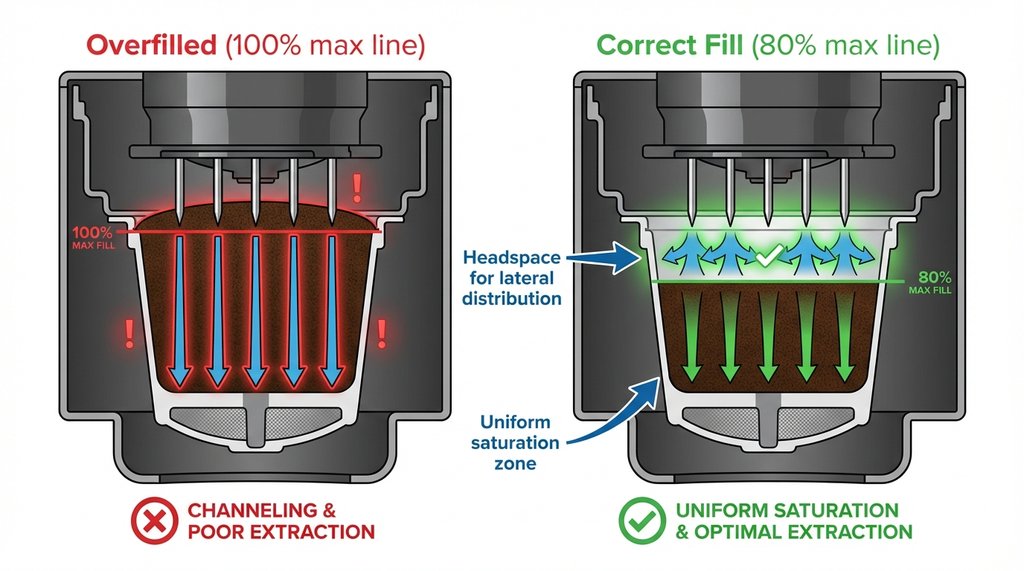
The practical fix: fill to about 80% of the max line, level the surface by tapping the pod on the counter (I do not tamp), and seat the lid firmly. That 20% of empty headspace above the grounds is not wasted space — it’s where the MultiStream water pattern expands before it contacts the bed.
I found this by accident when I accidentally underfilled a pod in a hurry one morning and noticed the cup tasted better than my careful full-fill cups had been. Ran the comparison systematically for a week and the 80% fill beat the full fill on every metric I could measure.
Cleaning and Longevity Notes
Reusable pods on any Keurig accumulate oils in the mesh or perforation points faster than most people realize, and the K-Supreme Plus’s five-needle puncture means you’ve got five small entry holes in the lid that need to stay clean or they’ll constrict flow unevenly.
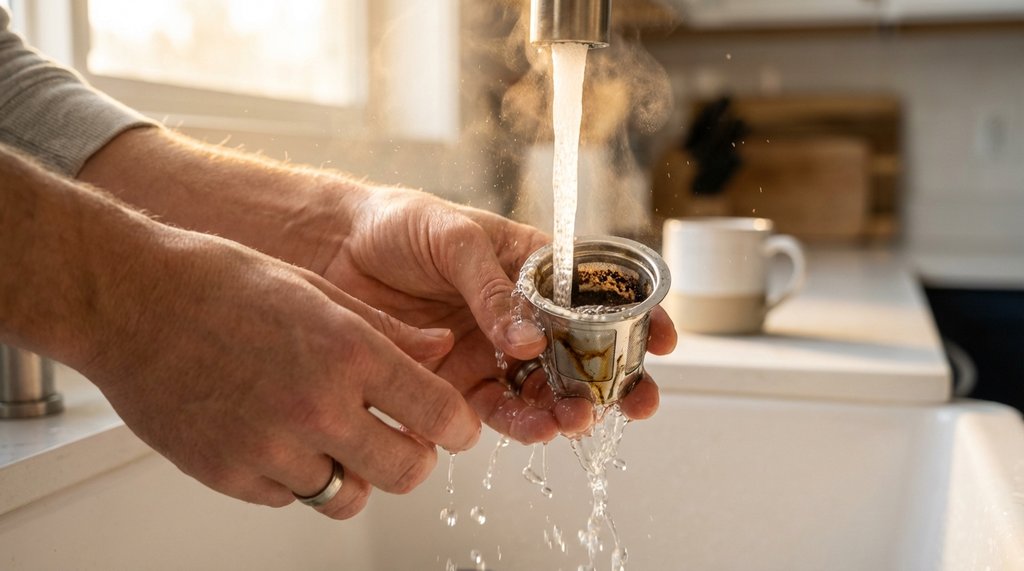
I rinse immediately after every use — flip it, run hot water through the mesh from both directions, thirty seconds. Once a week I soak the basket in a 1:10 white vinegar solution for about 20 minutes. I have not had a basket degrade in over 400 uses on the Delibru following this schedule. When I skipped the weekly soak for about three weeks (it was a hectic month), I noticed extraction TDS drop by about 0.1% consistently before I caught the cause.
One thing that bit me: I switched to a new descaling product for the machine itself in early 2024 — a Urnex product instead of the Keurig-branded descaler — and the residue from the first cycle after descaling noticeably affected cup flavor for about three brew cycles. Run at least three full water-only cycles after descaling before going back to a reusable pod if you’re trying to evaluate pod performance. I spent four days convinced my Delibru had finally started degrading before I traced it back to the descaler residue.
Which One to Actually Buy
If you’re starting from scratch with a K-Supreme Plus: buy the Delibru. It handles the MultiStream system better than anything else at its price point, the mesh filtration is genuinely superior to perforated plastic for this machine’s brew pattern, and the only real maintenance cost is occasional pod replacement.
If you already have the Keurig My K-Cup on hand: use it, it’s fine, but mind the fill level more carefully than you would with the Delibru — it’s more sensitive to overfilling.
If someone gifted you an older reusable pod because “that’s what works in Keurigs”: verify it has a MultiStream-compatible lid before using it. If it doesn’t, do not use it, or you risk breaking your brewer’s needles.
The grind sweet spot — medium-fine, finer than you’ve probably been told — is the single change that will do more for your cup quality than any pod swap. Get that dialed in first, then worry about which basket you’re using.